Spark Without Flame on a Dual Fuel Top
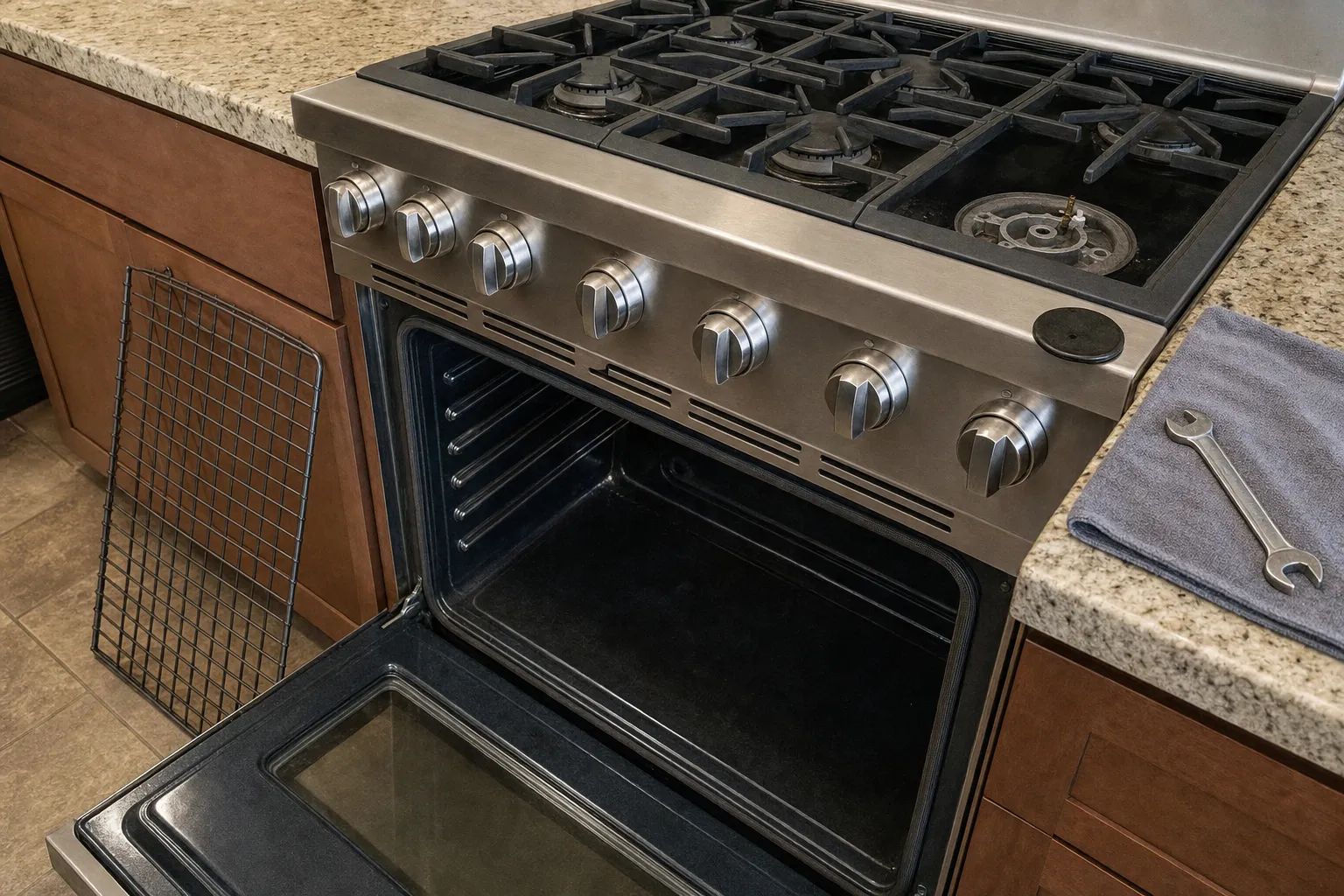
The knob goes to Hi, the igniter clicks, and the burner never catches. Sometimes the clicking stops as soon as the knob goes back to off; sometimes it carries on with every knob off. On a Wolf sealed burner the click itself is normal: Wolf’s guide says the igniter clicks until the burner lights. The question is why the flame never arrives to end it.
We read it from the top down: the cap and the burner head, then moisture, then the electrode, and only then the parts behind the knob.
Two kinds of clicking
Clicking that stops when the knob is turned off belongs to that burner. Gas and spark are both being asked for, and the flame is not forming. Clicking that carries on with every knob off belongs to the switches: something is telling the ignition to fire when nobody has asked, and moisture in a switch is one way that happens.
The spark itself tells us more. A crisp spark that lands on the burner, with no flame following, sends us to the gas reaching that burner and the way the flame bridges from the port nearest the electrode. A spark that is weak and yellow, or that jumps to ground somewhere else, sends us to the electrode.
Wolf’s own first steps
Wolf’s troubleshooting for erratic flame, poor ignition or no ignition on its current dual fuel ranges gives four owner steps, and they are the ones we ask about on the phone:
- The burner caps positioned properly on their bases.
- The burner and the igniter cleaned.
- After a spill, the area left to dry completely; Wolf allows a hair dryer to speed that up.
- The knob pushed in and released, to confirm that it springs back.
A cap lifted for cleaning and set back a few degrees out of true can block the flame path from the port nearest the electrode. Gas arrives, the spark is there, and the flame never bridges. Wet parts after a boil-over can take a long while to dry fully. Neither needs a part.
With the cap off
Past those owner steps the burner is ours. We close the range’s gas shut-off first, lift the cap and the head, and look at the ports for blockage and carbon. Nothing metal or sharp goes into a port. Then the electrode: intact ceramic and a clean tip, with no crack, chip or dark track down its body. A damaged electrode is a part, and it has to be the one listed for that model and serial, set at its correct gap when it goes back.
Then the switch behind the knob and the module that fires the spark. One burner affected on its own is usually mechanical. Several at once moves the question toward the module or the wiring behind it. Both are meter work, because a switch held closed and a failing module can sound alike, and replacing the wrong one is an expensive guess.
A smell of gas ends the diagnosis
If you can smell gas, stop trying the burner, leave the house without working switches, and call the gas utility from outside. Mercer Island Wolf Appliance Repair, (206) 785-2960, comes once the utility has made it safe.
Clicking that will not stop with every knob off is the other reason not to wait. The ignition is being held on, and the range is best left off at its breaker until it has been looked at.
One part, priced when found
A burner that will not light is close to the smallest fault a range can have. The igniter or spark module band and the valve or orifice band on our dual fuel cost page cover the main parts behind it, and a knob switch is quoted after the diagnosis. The $89 visit comes off the repair when you approve it. Mercer Island Wolf Appliance Repair, (206) 785-2960.
Follow-up questions
Can the other burners still be used while one keeps clicking?
If the clicking burner is turned off and there is no smell of gas, the rest of the top can be used. If sparking carries on with every knob off, stop using the range and call Mercer Island Wolf Appliance Repair on (206) 785-2960. If you smell gas at any point, leave the house and call the gas utility from outside.
Why does a Wolf burner keep clicking after a boil-over?
Liquid that reaches the burner or runs down behind a knob can stop the flame forming or hold the ignition on. Wolf's own step is to let the area dry completely, with a hair dryer if wanted, before the burner is tried again. If it still clicks once dry, Mercer Island Wolf Appliance Repair finds the wet switch or the damaged electrode.
Can a Wolf burner be lit during a power cut?
Yes. Wolf's use and care guide for its current dual fuel ranges says the surface burners can be lit by hand in an outage, with the knob at Hi and a multi-purpose lighter. The oven below will not heat until the power returns. If a burner still will not light by spark once it does, call Mercer Island Wolf Appliance Repair, (206) 785-2960.
Filed as B3 in Two Fuels, One Range, read in order with the rest of series B.
Written up by
Imogen Fairhurst
12 years in the trade · Cooking-appliance technician — ovens and calibration